When you order custom t-shirts, hoodies or uniforms, the first question is usually what the design will look like. The second, just as important, is how it gets onto the garment. The method you choose affects how the print looks and feels, how long it lasts, and what each piece costs.
Here is how the four most common methods compare, and how to choose between them.
Screen printing
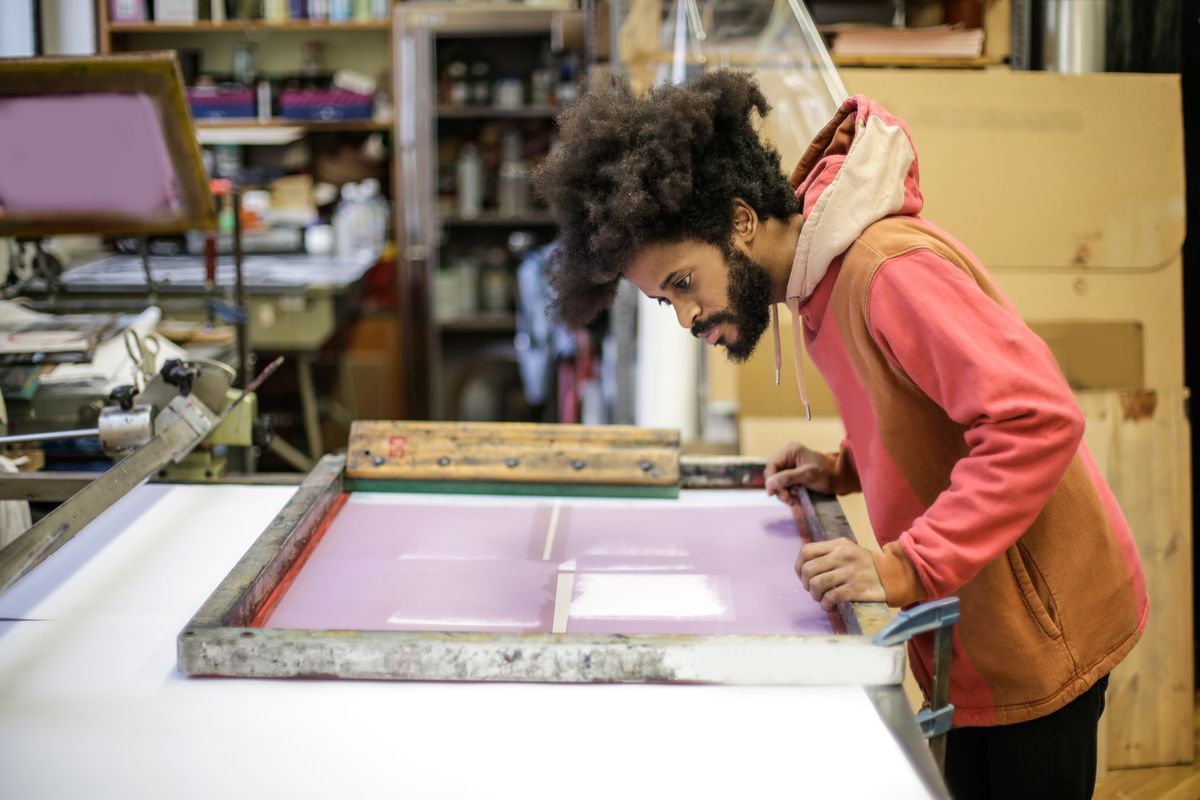
Ink is pushed through a fine mesh screen onto the fabric, one colour at a time. Each colour in your design needs its own screen, so there is a setup step before printing starts.
- Best for: bulk orders with one to six solid colours, such as event t-shirts, company merchandise and streetwear drops.
- Look and feel: bold, opaque colour that sits on top of the fabric and lasts a long time.
- Works on: cotton and cotton blends.
- Keep in mind: because of the setup per colour, it is most economical on larger quantities. Photographs and gradients are harder to reproduce.
DTF (direct-to-film) printing
Your artwork is printed onto a special film with a powder adhesive, then heat-pressed onto the garment. There is no per-colour setup, so a design with twenty colours costs the same to set up as a design with one.
- Best for: full-colour artwork, photos, gradients and smaller or mixed runs.
- Look and feel: smooth and flexible, with sharp detail.
- Works on: cotton, polyester and blends, in light or dark colours.
- Keep in mind: the print is a thin layer on the surface, so on very large designs you will feel it more than a screen print.
Sublimation
Special dye is printed onto paper, then heat turns it into a gas that bonds with polyester fibres. The design becomes part of the fabric rather than a layer on top.
- Best for: sports jerseys, all-over prints and activewear.
- Look and feel: nothing to feel at all, and it will not crack or peel.
- Works on: white or light-coloured polyester only.
- Keep in mind: it does not work on cotton, and it cannot print white or light colours onto dark fabric.
Embroidery
Your logo is converted into a stitch file (called digitising) and sewn onto the garment by multi-head embroidery machines.
- Best for: logos on polos, caps, jackets, uniforms and corporate wear.
- Look and feel: raised thread with a premium, long-lasting finish.
- Works on: most fabrics, including thick ones like fleece and twill.
- Keep in mind: very fine text and tiny details do not stitch well, so logos sometimes need simplifying. It suits small placements like a chest logo better than large designs.
Quick comparison
| Method | Colours | Best order size | Fabric |
|---|---|---|---|
| Screen printing | 1 to 6 solid colours | Bulk | Cotton, blends |
| DTF | Unlimited, including gradients | Small to medium | Cotton, polyester, blends |
| Sublimation | Unlimited | Any | Light polyester |
| Embroidery | Usually up to about 12 thread colours | Any | Most fabrics |
How to choose
- Start with the fabric. Polyester sportswear points to sublimation. Cotton t-shirts point to screen printing or DTF. Polos and jackets often look best embroidered.
- Count the colours in your design. A one or two colour logo screen prints beautifully. A photo or a design with gradients needs DTF or sublimation.
- Think about quantity. For a few dozen pieces with a detailed design, DTF usually makes sense. For hundreds of pieces with a simple design, screen printing usually wins on cost.
- Think about how it will be used. Uniforms that get washed every day need a durable finish, such as embroidery or a good screen print.
You don't have to decide alone. Send us your artwork with the quantity and fabric you have in mind, and we will recommend a method with your quote. You can also read more about each method on our printing page.